AI Will Drive $20 Billion in US Online Sales This Year, and It Shops From Product Feeds, Not Ad Campaigns
Brands are chasing ChatGPT ads while AI agents reshape how people buy. eMarketer expects AI to drive $20.57 billion in US online sales this year, and agents shop from product feeds, not ad campaigns.
Rémi Kerhoas has spent his career buying performance media, so it lands differently when he tells marketers to stop staring at ChatGPT ads. In a July 13 column for Search Engine Land, the performance director at the search agency Eskimoz made the case that AI’s real weight on marketing lands at the checkout, where an agent completes the purchase long after an ad would have done its job.
“The real shift isn’t advertising on LLMs like ChatGPT. It’s happening in checkout flows, voice assistants, and agentic commerce infrastructure, where the transaction itself becomes the ad unit.”
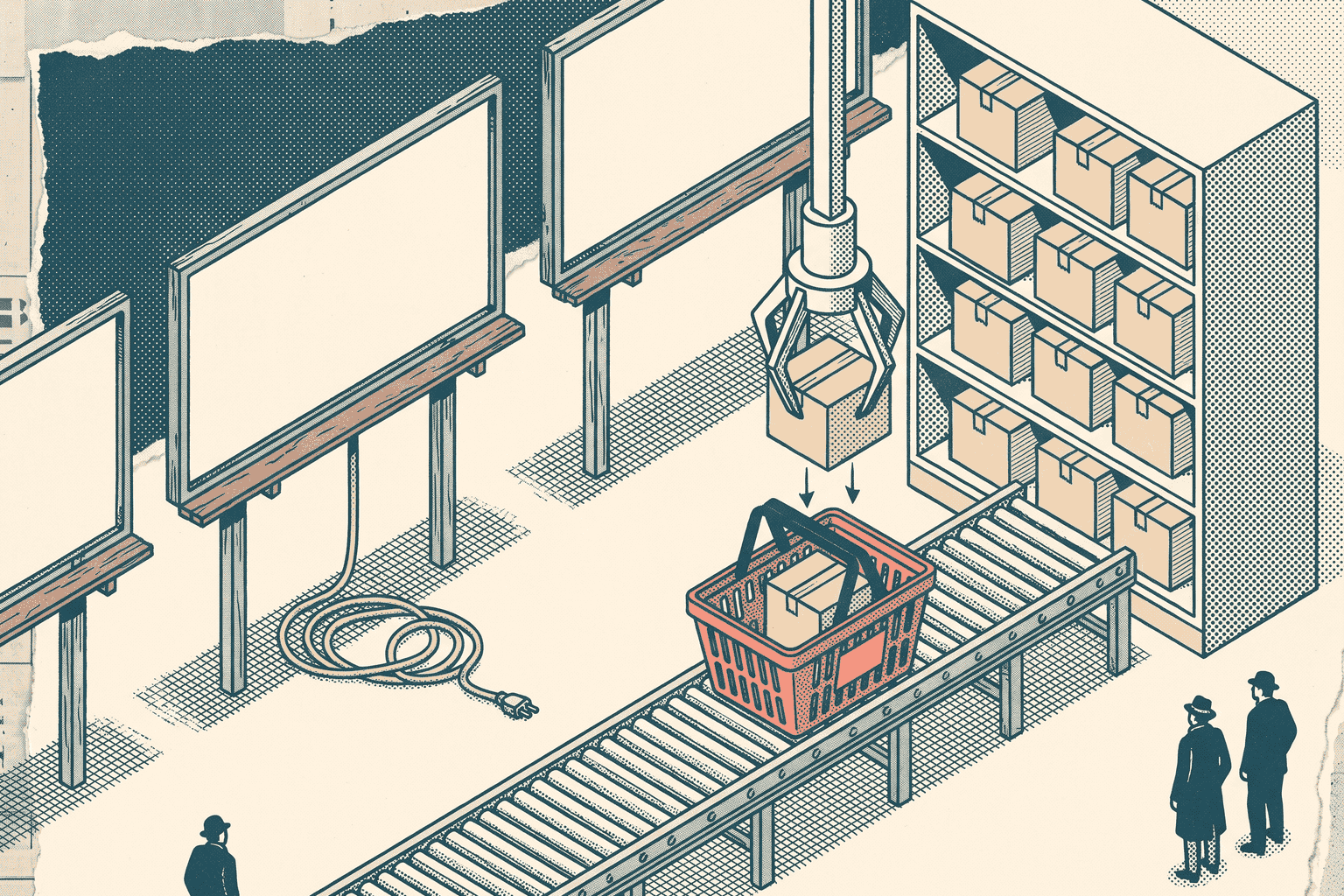
Here’s the mechanism that should reorder a 2026 budget. When an AI agent buys on a customer’s behalf, it doesn’t watch a campaign. It reads a product feed, the structured file of prices, titles, attributes, and availability that a retailer hands to a platform.
The ad you tuned all quarter never enters the transaction.
“Agentic commerce” is shorthand for AI that completes the purchase, not just recommends it, and the money behind it is no longer hypothetical. eMarketer expects AI platforms to drive $20.57 billion in US online retail sales this year, roughly 1.5% of the total and nearly four times the 2025 figure. McKinsey puts the 2030 opportunity at $3 to $5 trillion globally. Over Cyber Week 2025, eMarketer notes, Salesforce found AI and agents influenced 20% of global orders, and Adobe clocked a 670% year-over-year jump in AI-driven traffic to US retail sites.
The infrastructure is being poured now. Google introduced a Universal Cart and a Universal Commerce Protocol at its I/O conference this year. Amazon folded Rufus, its shopping assistant with more than 300 million users, and Alexa+ into a single Alexa for Shopping. OpenAI added product-feed integrations to its own ads manager. Each one is a road that routes a buyer to a product without a marketer’s creative in the middle.
Set that against the thing marketers are actually fixated on. ChatGPT’s US user base has been essentially flat since September 2025, and OpenAI booked roughly $13 billion in revenue against $34 billion in costs last year, an operating loss near $21 billion. A business under that kind of pressure sells ads because it has to. Kerhoas is blunt about what that makes them:
“Ads are a defensive move, not a strategic vision.”
The operators closest to the buy are already acting like the feed is the battleground. Rachel Levy, COO of the bedding brand Brooklinen, told eMarketer her team pays influencers to post about products “knowing that text and audio transcripts will be scraped by AI crawlers.” The spend is aimed at the data an agent will later read back.
This is the same lesson arriving from a second door. OpenAI’s own ad forecast looks about 90% too high against what analysts think the chatbot ad market can bear, and the shift of search into AI answers keeps moving buying decisions into places you can’t purchase your way into. In both, the cleanest data beats the biggest ad budget.
The practical work is unglamorous, which is why most teams skip it. Product feeds have to be complete, accurate, and updated close to real time, because an agent that can’t confirm a size, a price, or whether an item is in stock simply moves to the listing it can trust. That’s generative engine optimization, the work of structuring product data and content so an AI can extract and cite it, the same muscle as the old SEO but pointed at machines that buy. eMarketer’s readiness data says almost nobody has built it: only 11% of retailers report being ready to scale AI across operations.
The budget question for the back half of the year is simpler than the ad debate: can an agent find, trust, and buy your product without a human in the loop? If the feed is stale, the ad was never the problem. Fix the feed, then argue about the ad.
Quoted in this story
Want your perspective in coverage like this? Get quoted.
Sources
- Search Engine Land: Why agentic commerce will matter more than ChatGPT ads
- EMARKETER: FAQ on agentic commerce: how brands should act now to compete
- Search Engine Land: OpenAI adds product feed ads to ChatGPT
This story is part of our running coverage: the full picture →
Get Net Effect.
The net effect of AI on your marketing: the stories that matter, twice a week, in five minutes.