Rent the Algorithm. Own the Audience.
AI marketing money compounds in one place and burns in another. The dollar you hand to the ad platforms works. The one you spend building your own agent doesn't. Budget accordingly.
On April 29, Meta told investors it booked $56.31 billion in the first quarter of 2026, up 33% from a year earlier. One line in the same report should change how you budget. The number of advertisers using at least one of Meta’s AI ad tools had doubled to 8 million, from 4 million at the end of 2024.
That is AI in marketing working. Compounding, even.
Now hold it next to the other number. In May, Gartner reported CMOs had moved 15.3% of their budgets into AI, and that only 30% felt ready to scale it. Boston Consulting Group, surveying more than a thousand companies, found just 5% capturing real value. We wrote up that gap when it landed: the spend went up and to the right, and the proof stayed a flat line behind it.
Same technology. Same quarter. Two completely different outcomes.
Most of the debate right now is about which AI tools to buy, or whether to build your own agent. I think that’s the wrong argument. The money already settled whether AI pays in marketing. It hasn’t settled where.
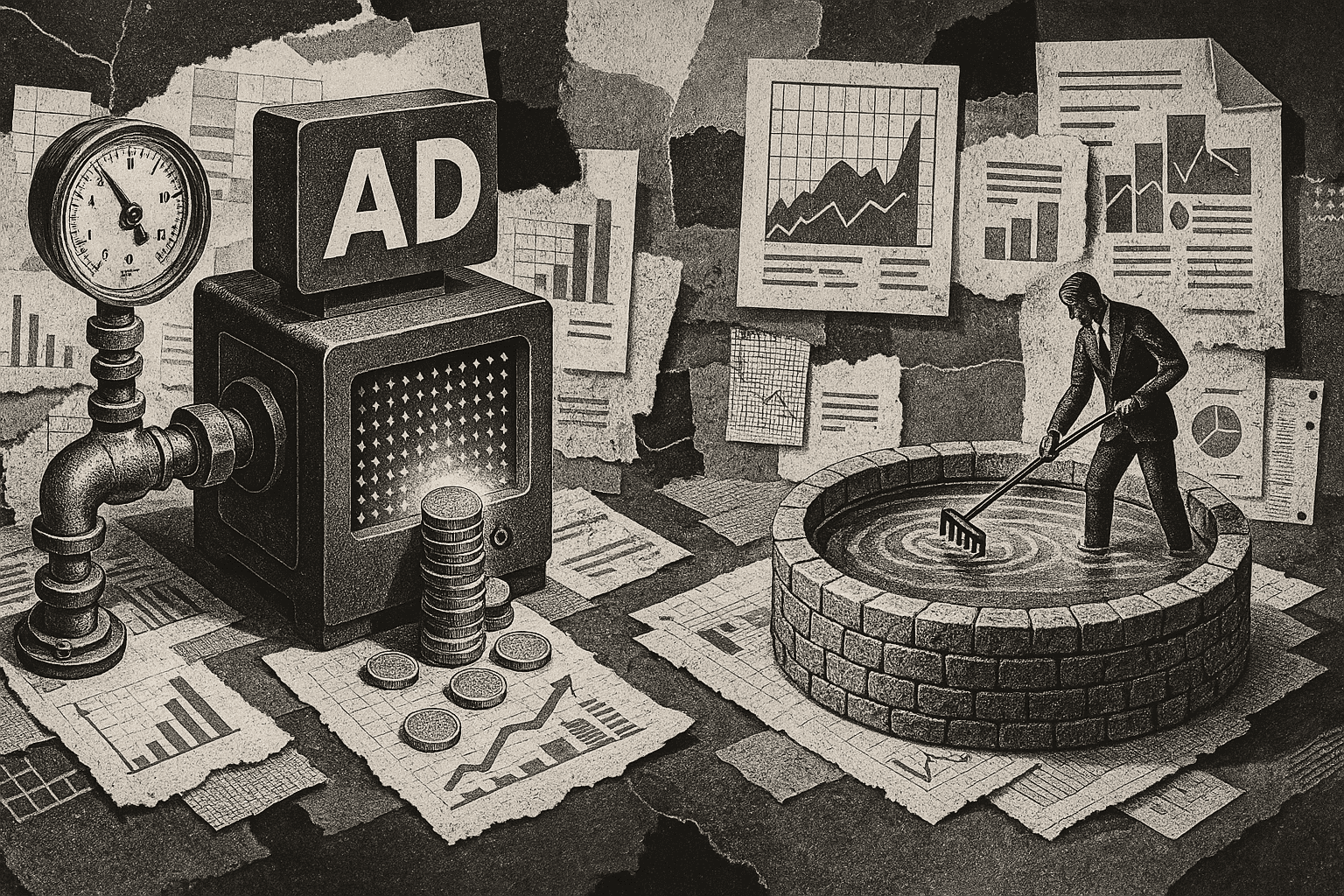
Here’s where I’ve landed, and I’ll put my name on it. AI marketing money returns in one place and burns in another. It compounds when you rent it from the ad platforms. It drains away when you try to rebuild it in-house. So budget for that split on purpose: rent the algorithm, and move the money you save into the one thing AI can’t hand your competitor.
The platform side of that isn’t a close call. Meta’s ad engine watches billions of ads a day and learns which ones actually lead to a sale. When you put budget into it, you’re buying a system that gets sharper the more everyone uses it. Google and Amazon run the same machine. This is the AI a small team actually wants, and you already get to rent it by the dollar.
In-house is where the budget quietly dies. Gartner booked that 15.3% before most of the readiness existed. A third of the largest marketing teams were told to cut costs 20% with AI as the reason before anyone could show the savings. And the custom agent that was supposed to justify it costs, every time it runs a task, close to 30 times what a simple chatbot did in 2023. Gartner expects 40% of these AI agent projects to be scrapped by the end of 2027. One of these bets gets smarter as it runs. The other just gets more expensive.
The strongest objection here is a fair one. Those 5% BCG found weren’t lucky. They rewired the company around AI, and the reward was real. So build the capability in-house and join them.
I don’t buy it for the teams I write for. The companies capturing that value sit on a private data advantage that grows every quarter. Think Amazon, seeing every search, purchase, and return. A 25-person B2B software team has no such advantage, and it isn’t going to out-build a trillion-dollar ad system in its spare time. For almost everyone, “build it in-house” means paying to rebuild a worse version of what Meta will rent you for less.
So think of your AI budget as two lines, not one.
The first is the rent line, the money you hand Meta and Google to run your ads. It runs on someone else’s computers, and you pay for how much the AI reads and writes. Even as that price drops, your bill climbs, because the tools keep doing more each time. You don’t control it, and you’re not trying to. You’re renting a utility.
The second is the moat line, what you put into your brand and your own email list, the things that stay yours. We argued a while back that brand and an audience you own are the last real moat in this era. Both are a kind of memory: what a buyer already knows and feels about you before they ever search. No amount of computing power manufactures that. AI can write a million versions of your campaign. It can’t make a stranger trust you, and it can’t hand a competitor the subscriber list you built and don’t rent from an algorithm. Rent the machines. Own the memory.
That reallocation is already starting to run in reverse, which is what makes the timing worth a call. Forrester expects enterprises to defer a quarter of their planned AI spend into 2027 as the pressure to show returns hits. “In 2026, the AI hype period ends as the pressure to deliver real, measurable results from secure AI initiatives intensifies,” wrote Forrester’s Chief Research Officer, Sharyn Leaver. When a CFO runs that audit, the line that survives is the one with a platform’s return sitting next to it. The custom-agent line, the one that reads as a variable bill with no pipeline attached, goes first.
So here’s the dated version, the one you can hold me to. By the end of 2027, the teams that can show a real return on AI will overwhelmingly be the ones who spent it on platform-run advertising, not on in-house agents, and the in-house agent budget will be the first thing the finance team cuts. What would change my mind: a cheap, open tool that lets a small team build a data advantage it genuinely owns. Something that grows on its own, without a tech giant like Google or Amazon underneath it. I don’t see it yet. If it ships, the math flips and I’ll say so.
Until then, the moves are boring and they work.
Treat platform AI like electricity. Meter it, tune it, don’t staff a team to rebuild what the ad system already does for a fraction of the cost.
Take the budget you were about to spend building your own agent and put it on the moat line, the brand and the audience no algorithm can revoke overnight.
And before you fund any in-house AI build, ask one question: what here compounds? If the honest answer is “the vendor’s model,” you’re renting either way. Rent it cheaper and go spend the difference on something that’s yours.
The winning AI budget in 2026 is the one that knows which dollars to hand away and which to defend.
Quoted in this story
- Sharyn Leaver, Chief Research Officer, Forrester (source)
Want your perspective in coverage like this? Get quoted.
Sources
- PPC Land: Meta Q1 2026: $56.3B revenue as AI tools double advertiser adoption
- Gartner: Gartner 2026 CMO Spend Survey: CMOs Allocate 15.3% of Marketing Budgets to AI
- Boston Consulting Group: Are You Generating Value From AI? The Widening Gap
- Forrester: Forrester's 2026 Technology & Security Predictions
- EY: Agentic AI: understanding the token costs
This story is part of our running coverage: the full picture →
Get Net Effect.
The net effect of AI on your marketing: the stories that matter, twice a week, in five minutes.